

Stock Exchange Of Thailand Eases Listing Rules From Sept. 11 After A Single IPO In Six Months
The index is up close to 30 percent this year and ranks among the world's best performers. In the same period the exchange hosted one flotation, raising about $10 million. Singapore hosted five and raised more than a billion.
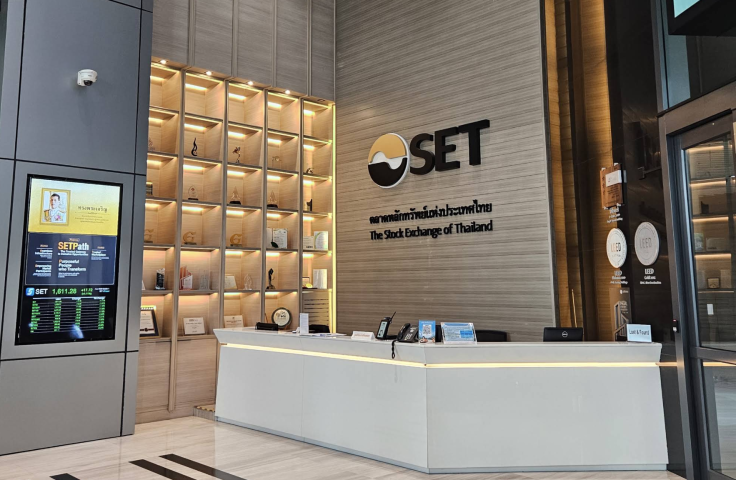
BANGKOK — The Stock Exchange of Thailand has amended its listing criteria, with the changes taking effect on Sept. 11, in an attempt to draw companies to a market that has performed strongly for investors and almost entirely failed to attract new ones.
The revisions cover 10 targeted industry groups the exchange describes as New Economy sectors, among them advanced medical and healthcare, next-generation automotive and smart electronics. They introduce a dedicated track for businesses promoted by the Board of Investment and the Eastern Economic Corridor Office, and adjust public offering criteria for foreign companies already listed on overseas exchanges, allowing them to use their existing listings when applying in Bangkok.
SET president Asadej Kongsiri said in a statement on Friday that the business structure of Thailand's listed companies has barely changed over three decades, while New Economy industries have grown exponentially and need genuinely accessible funding. The revision forms part of the exchange's three-year strategic plan running to 2028.
The gap the rules are meant to close
The scale of the problem is easier to see in the flotation numbers than in any strategy document.
The Stock Exchange of Thailand hosted one initial public offering in the first half of 2026, raising US$10.4 million. The Singapore Exchange hosted five, raising US$1.05 billion between them. Across the Asia-Pacific region there were 247 flotations over the same period, raising US$47 billion, according to the consultancy EY.
Thailand and Singapore share a diagnosis, in the view of some investors: both are weighted toward finance and real estate and lack a critical mass of technology companies. Singapore, on these numbers, is failing at that considerably less expensively.
The paradox
None of this is happening in a bad market. That is what makes it interesting.
The SET Index has risen by close to 30 percent since the start of the year, which Asadej said in late August ranked it fourth globally. Foreign investors had recorded net purchases of 67 billion baht year to date. Thailand's credit rating has been upgraded by major agencies. The exchange's Thailand Focus conference in August drew 220 institutional investors from 74 financial institutions, including participants from Switzerland, New Zealand and Israel for the first time.
So money is arriving. Companies are not. An exchange can rise on the strength of its existing constituents while remaining unattractive as a place to list, and Thailand is currently demonstrating exactly that.
Why companies go elsewhere
The reasons Thai firms give have been consistent and have little to do with listing criteria.
Kasikorn Securities has said Thai companies are increasingly being approached and encouraged to list in Singapore and Hong Kong, which offer higher trading liquidity and faster listing processes. Regulators have separately acknowledged that even a well-prepared company can be forced to postpone a listing by unfavourable market conditions, economic uncertainty or government policy.
Liquidity and speed are structural. Criteria are administrative. The Sept. 11 changes address the second category, and the exchange has not claimed otherwise.
The timing problem
There is also a gap between when the rules arrive and when anyone can use them.
Asadej has said it may take up to two years for New Economy companies to reach a listing, because many are still early in their operating lives. The exchange has disclosed a near-term pipeline of ten companies — five approved, five under review — which is the realistic supply for the coming period regardless of what the new criteria permit.
Rules effective in under a week, then, aimed at a class of company that may begin arriving in 2028.
An awkward adjacency
One target sector is worth noting carefully.
The exchange and the Board of Investment have been working to attract data centre, semiconductor and printed circuit board companies to raise capital in Bangkok rather than relying on overseas parents, with reduced market capitalisation thresholds among the inducements discussed.
On Thursday, a government policy board ordered a pause on 166 data centre projects while four subcommittees spend a month drafting national standards on power, water, siting and safety. Both decisions are defensible on their own terms — one seeks investment, the other seeks control of its consequences — and they were taken by different arms of the state within two days of each other. Neither has been reconciled with the other in public.
What to watch
Whether any New Economy company actually files under the new criteria this year. The rules take effect Sept. 11. A filing before December would suggest demand was being held back by eligibility rules. Nothing before 2027 would suggest the constraint was always liquidity.
Whether the ten-company pipeline converts. Five approved and five under review is a concrete, checkable number. How many reach a listing, and how much they raise, is the clearest available measure of whether any of this is working.
Whether foreign inflows hold if the index stalls. The 67 billion baht of net foreign buying arrived during a 30 percent rally. Money that follows momentum tends to leave with it, and the listing reforms are a long-term project that will need several years of patience the market may not supply.