

Thailand To Shift From LNG Toward Renewables In Wake Of Iran War
Thailand's Energy Strategy: Reducing LNG Dependence and Boosting Renewables
KEY POINTS
- Thailand relies on natural gas for roughly 58-66% of its electricity generation, leaving it exposed to global LNG price shocks
- The cost of securing spot LNG cargoes has surged by an estimated 125% since the Iran war disrupted Middle East energy supply
- Policymakers are now pushing to accelerate renewable energy deployment in the country's next Power Development Plan
Thailand is moving to reduce its reliance on imported liquefied natural gas and accelerate its shift toward renewable energy, after months of war-driven disruption in the Middle East exposed just how vulnerable the country's gas-dependent power system had become.
Natural gas remains the backbone of Thailand's electricity generation, accounting for more than half of power output — with estimates ranging from around 58% to 66% depending on the year and methodology used. Roughly a third of that gas is imported as LNG, a share that has left the country badly exposed as the US-Israel war against Iran disrupted shipping through the Strait of Hormuz and rattled global energy markets.
The financial impact has been steep. The cost of securing a spot LNG cargo has jumped by an estimated 125% since the conflict began, driven by a spike in benchmark LNG prices from roughly $11 to $23.50 per million British thermal units, compounded by a weaker Thai baht. With gas-fired power becoming both more expensive and increasingly underused, energy officials now see the crisis as a turning point rather than a temporary shock.
A Region-Wide Pullback From LNG
Thailand isn't alone. Across Asia, the war has done lasting damage to LNG's reputation as an affordable, secure long-term energy source, with countries including South Korea, India, the Philippines and Cambodia all taking concrete steps to accelerate clean energy deployment and reduce gas dependence. LNG projects have already been shelved in China and Vietnam, and Asia's LNG imports plunged in March as the conflict effectively took roughly a fifth of global LNG supply offline.
Analysts say the shift may prove durable rather than temporary. Researchers at Columbia University's Center on Global Energy Policy have argued that persistent supply cuts and high replacement costs will push the region to invest less in future LNG demand growth, leaning instead on a mix of renewables and, in some cases, coal.
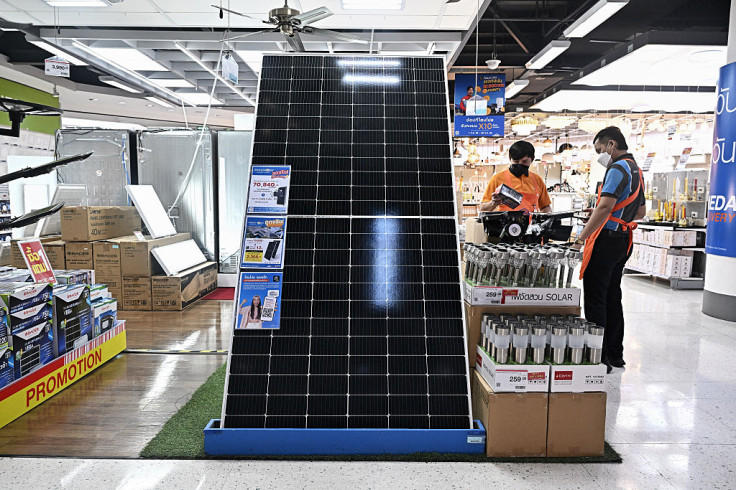
The Case For Solar
For Thailand specifically, the math increasingly favors renewables. According to analysis from the Institute for Energy Economics and Financial Analysis (IEEFA), the country's existing 7.1 gigawatts of solar capacity could displace an estimated 1.3 LNG cargoes' worth of fuel per month, avoiding close to $119 million in costs at current prices. IEEFA estimates that every additional gigawatt of solar capacity could help avoid roughly $3 billion in fuel costs over its lifetime.
That case is now expected to feed directly into policy. Thailand's forthcoming Power Development Plan (PDP) — the country's long-term blueprint for electricity generation — is seen as an opportunity for policymakers to set more ambitious renewable energy targets and reduce the country's structural exposure to gas markets, though doing so will likely require reforms to electricity market rules to draw in more private investment in renewable projects.
Even as it pursues that shift, Thailand has continued to hedge in the near term: the government has also pursued a preliminary supply agreement with Russia's largest LNG exporter, underscoring how difficult it remains for import-dependent economies to walk away from gas entirely, even as they plan for a future built more heavily around renewables.